Two stories fit a dribble
Spoilers for the demo, so try it first.
Switch the fountain on and the card fills in three lines of free evidence. The nozzle gives "a weak dribble." The motor is "running smooth." The suction line is "steady." So the pump isn't seized, the motor isn't dead, and the suction line isn't starving.
That still leaves two stories. Either the pump is spinning but too worn to push, or it's pushing fine against a nozzle half full of grit. Both give you a dribble. From the patio, they sound exactly the same.
One gauge on the pump outlet splits them:
| what's broken | pump outlet | nozzle | motor |
|---|---|---|---|
| nothing (for reference) | 162 kPa | 18.0 L/min | 3.0 A |
| worn impeller | 46 kPa | 5.1 L/min | 3.0 A |
| nozzle partly blocked | 240 kPa | 2.5 L/min | 3.0 A |
(kPa is pressure. Higher means more push.)
Low pressure means the pump itself is weak. High pressure means it's working hard against something downstream. The coach in the game puts it as "PILED HIGH" versus "COLLAPSED." Read 46, call the impeller (the spinning part inside the pump that does the pushing), and the fountain jumps.
The first shop wasn't even wrong about where. A whole new pump assembly comes with a new impeller in it. It's just the $400 way to buy a $28 part.
Nobody wrote a single reading
Most mysteries have a writer. Someone decided what the clue means, and you're guessing what they were thinking.
SECOND OPINION has a writer for the customers and the jokes, not for the readings. Each machine is a small circuit of pipes and wires, and one solver works out every pressure, flow, voltage and current in it. A fault never sets a gauge. It changes one part, like an impeller that now pushes at a quarter of its usual pressure, and the solver does the rest. Your call gets checked against that same broken part. There isn't a second source of truth for the game to get wrong.
Don't take that on faith. The game ships with a script that tries every fault on each call's suspect list and checks four things. Each fault reads differently from every other on the list, at the precision you actually see. The free evidence never hands you a call's main fault. The fewest probes that pin each fault fit inside your tokens. And the senior's par for the main fault is never lower than that. The last line it printed:
FAIRNESS GATE: all cases provably fair. ✔
You can guess. It costs.
There's no fail screen. You can always finish a call. But a wrong call works the way it does in real life: the shop fits the part you named, it comes back from the bench "NO FAULT FOUND," and "It's on the customer's bill anyway." The machine is still broken, and your best possible grade just dropped.
You also have to name the fault, not just the part. "Pump" isn't a call. "Pump: worn impeller" is. Get the part right and the story wrong and the fix holds, but the write-up doesn't, and the job card says so.
Three stars means a clean call, first try, inside the senior tech's par. On call 1 that's two probes.
Seven calls. $5,960 in first-shop quotes.
- The fountain that quit. Mrs. Okafor, $400 from the first shop, and the call in the demo above.
- The sad espresso. Dario runs Café Vesuvio. "My regulars are starting to say things." First shop: $310, "pump's gone, they always go." This one teaches you to read pressure on both sides of a part.
- The sinking tank. Priya tops up the aquarium every morning, and "by Friday the angelfish look nervous." The leak is somewhere behind the wall. First shop: $650 to re-plumb the whole run.
- The dead mister. Bram's greenhouse misting rig is stone dead. "Orchids are judging me." First shop: $520 for the motor and pump as a unit. You walk the voltage down the wire.
- The cold radiator. Mr. Halloran bled the cold one himself. "Don't tell me I did it wrong." First shop: $380.
- The lukewarm tub. Sandra and Dee's anniversary weekend. It's been heating since noon. First shop: $900 for the heater and the control board. This one plays out over time, on a fast shop clock.
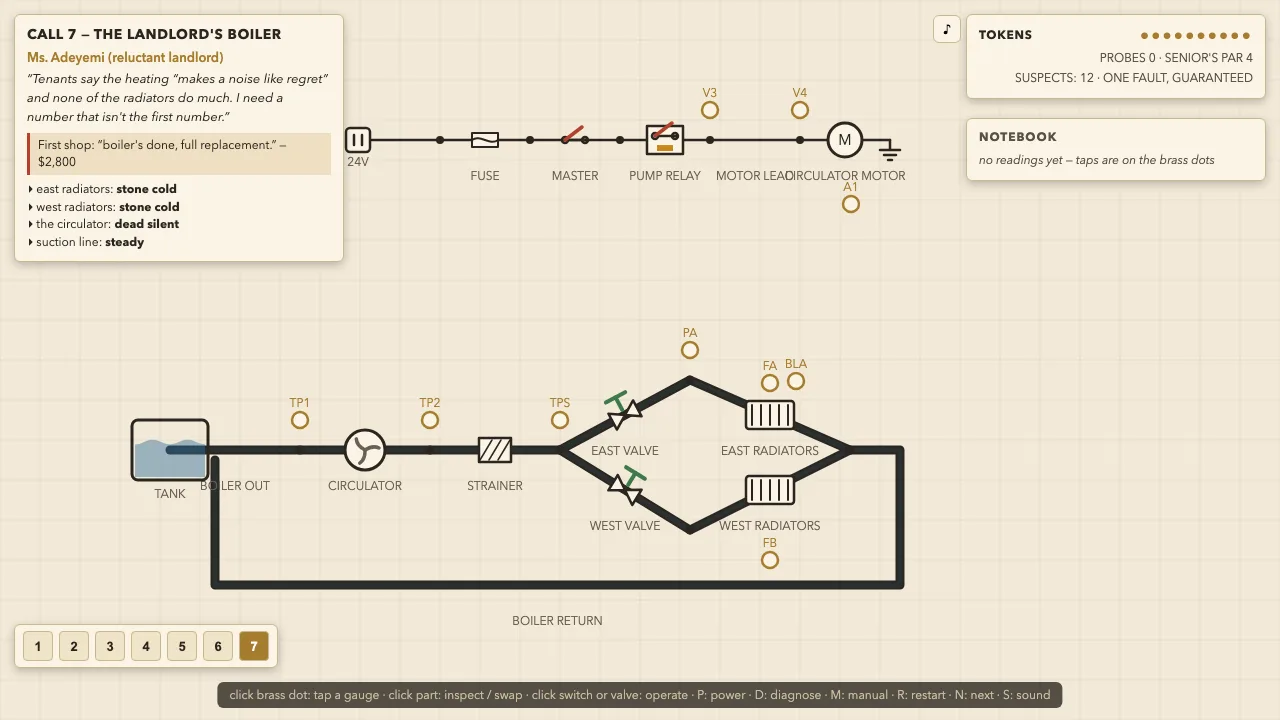
- The landlord's boiler. Ms. Adeyemi's tenants say the heating "makes a noise like regret." Twelve suspects, ten tokens, and no coach.
Add up the first shop's quotes and you get $5,960. The game tells you three real repair prices. The impeller is $28. Bram's relay is $6. As for the third, it's the landlord's, and I'm not going to spoil it.
If you fix things for a living
You'll see what's simplified, so here it is:
- Every machine runs on 24-volt control power and a few pipes. Nothing is to scale.
- There's one fault per call, always. No two problems hiding behind each other, and no faults that come and go.
- The model is linear. A pump is a pressure source with some resistance in it. Real pumps have curves.
- You never get dirty hands. A swap costs two tokens and takes no time.
What it gets right: bracket the fault between a good reading and a bad one. Halve the chain when you're tracing volts. A corroded relay can still pass a few volts, just not enough to run anything. And the expensive part next to the problem is usually not the problem.
Honest gripes
- It's seven calls. Replay one and it's the same fault, so the only thing left to chase is the par.
- Making the call needs the D key. There's no button for it yet, so the full game needs a keyboard, and the layout wants a laptop-sized screen. The demo above works on a phone.
- The art is a schematic on workbench paper: pipes, wires and brass dots, with no characters on screen.
- Nobody has played it outside automated test runs, so I can't tell you how long it takes.
Questions
- Is it free?
- Yes, with no account and no ads.
- Do I need to know plumbing?
- No. Call 1 coaches you through every step, and the field manual (M) lists what each part can do wrong and how it shows up. It gives you the vocabulary, never the answer.
- Controls?
- Click a brass dot to read a gauge, or a switch to flip it. Any other part opens a card where you can swap it or turn its valve handle. P is power, D makes the call, M opens the manual, R restarts the call.
- What if I'm stuck?
- Spend tokens. Swapping a part for a known-good one is expensive, but if the machine comes back, you found it.
- Does it save?
- Your stars do, in your browser. Finish the demo and call 1's stars carry over to the game, as long as you open it in the same browser.
- Phone?
- The demo, yes. In the full game, making the call takes the D key, so it wants a laptop. On a phone, the Send it to your laptop button passes the link along.
The landlord needs a number that isn't the first number
The first shop told Ms. Adeyemi the boiler's done. Full replacement, $2,800. You get ten tokens and no coach. The gauges will tell you which part it is, if you ask the right ones.
Play all seven callsFree, and there's no account to make.
P.S. Mr. Halloran was right. He bled that radiator properly, and the game will tell you so once you find what's actually wrong with it.